The Dancing Lesson
Thomas Eakins · 1878
Explore the painting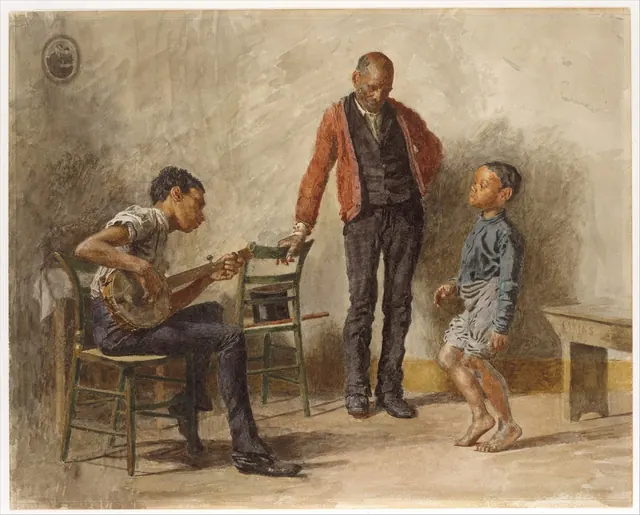
The painting’s story and details
A barefoot boy dances to a banjo while an older man watches, resting a hand on a chair. Eakins made this watercolour in 1878. The three Black figures belong to different generations; their precise relationship is not established. The room and shared activity suggest a family circle. The country’s history enters through a small image on the wall.
The musician bends over his instrument. One hand plucks near its round body while the other holds the neck. The banjo developed through the musical traditions of enslaved Africans and their descendants in the Americas, combining West African and European forms. In this room, it connects people without sheet music or a concert stage, through playing and answering movement.
The boy bends his knees, raises a heel and holds an arm slightly out for balance. He looks up towards the older man. His body occupies a transitional position between steps. Eakins studied anatomy before training in Paris, and everyday movement remained a recurring subject.
The older man stands almost upright. His red jacket separates him from the pale wall, and his hand connects him to the empty chair. He stands between musician and child without blocking either. Different forms of participation are distributed across the room: playing, dancing and watching. The title The Dancing Lesson does not establish exactly who is teaching whom.
On the left wall is a reproduction of a photograph of Abraham Lincoln with his son Tad. The museum connects it with emancipation and the watercolour’s family theme. The president appears beside a child rather than in a ceremonial pose. This small domestic image joins the memory of a public event to the lives of different generations in one room.
Eakins placed his signature and date on the wooden bench at the right. Wall, floor and furniture are built from broad transparent watercolour areas, while denser marks describe faces and hands. The paper shows through, contributing to the room’s light. This work earned the artist his first award, a silver medal at a Boston exhibition in 1878.
Slavery had been abolished, but equality remained contested. After Reconstruction ended in 1877, political and legal restrictions on Black Americans intensified. Domestic calm cannot therefore stand for the condition of the whole country. Lincoln on the wall recalls emancipation, while the scene preserves something else of consequence: music, skill and companionship belonging to these people.
Featured in tours
For children. Everyday life before us
Homes, school, trains and games in twelve paintings. For ages 8–12 and adults.
More paintings to compare

Period, style and subject
- Movement
- Realism
- Genre
- Everyday life
- Medium
- Watercolor on off-white wove paper
- Collection
- The Metropolitan Museum of Art
- Dimensions
- 45.9 × 57.3 cm
- Accession number
- 25.97.1
Sources
Image provided under CC0. Image licence