The Champion Single Sculls (Max Schmitt in a Single Scull)
Thomas Eakins · 1871
Explore the painting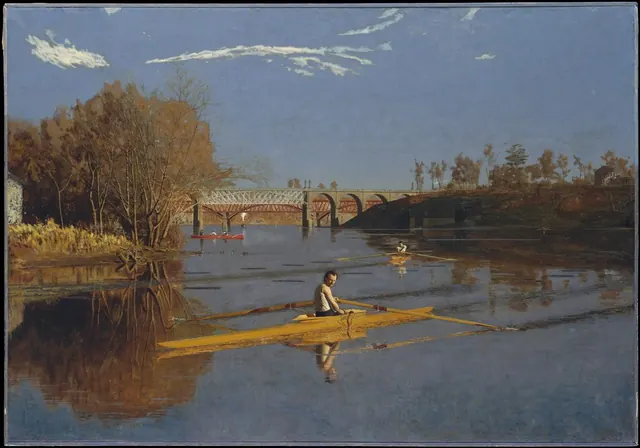
The painting’s story and details
Max Schmitt turns towards us from a narrow racing shell. He was Eakins’s school friend, a lawyer and an amateur oarsman. The 1871 painting probably commemorates his victory on the Schuylkill the previous autumn. Yet there is no finish line or crowd of supporters. The champion rests on the water, surrounded by the bridges, banks and other boats of his city.
A white vest leaves Schmitt’s shoulders and arms exposed. He turns his head and upper body while balancing in the shell. Before travelling to Europe, Eakins attended anatomy classes at a Philadelphia medical college; in Paris he later studied under Gérôme. Knowledge of the human body served him in an everyday sporting scene, where posture depends on skill and the construction of a boat.
The yellow hull stretches across most of the foreground. Oars extend to either side, their reflections introducing further diagonals. The shell looks light, but moving it requires coordinated action by both arms. Eakins sets the athlete’s face among precisely connected parts. Body, oars and narrow hull form a working system; strength alone cannot keep it balanced on the water.
Farther out, near the middle of the river, the painter himself is rowing. Unlike Schmitt, he is in motion. Eakins was an enthusiastic oarsman and chose a familiar activity for the first major work of his sporting series. After returning from Europe in summer 1870, local friends and familiar places supplied subjects for his independent career. His Parisian training found a use on a Philadelphia river.
Two bridge structures overlap behind the boats. Stone arches and metal lattice form a dense horizontal band. Eakins prepared separate bridge drawings, combining them with figure and composition studies. The convincing space was planned in advance.
On the left, bare branches are reflected almost whole, while traces of the oars disturb the surface around the boats. Autumn trees and fixed bridge piers make those small disturbances visible. The painting remains calm even where movement occurs. Life continues across the river and beneath the bridges, but no audience gathers around its principal figure.
In Philadelphia after the Civil War, rowing became popular among middle-class men. Scholars connect its prestige with an interest in health, leisure and physical discipline. Schmitt the lawyer belonged to that world. His achievement depended on neither inherited rank nor military office. An artist’s acquaintance, whose skill could be tested over a racecourse, takes the central place in a major painting.
Featured in tours
American landscape. Land and its inhabitants
Nature, territorial expansion, the Civil War and urban life in American painting.
More paintings to compare

Period, style and subject
- Movement
- Realism
- Genre
- Everyday life
- Medium
- Oil on canvas
- Collection
- The Metropolitan Museum of Art
- Dimensions
- 81.9 × 117.5 cm
- Accession number
- 34.92
Sources
Image provided under CC0. Image licence