The Chess Players
Thomas Eakins · 1876
Explore the painting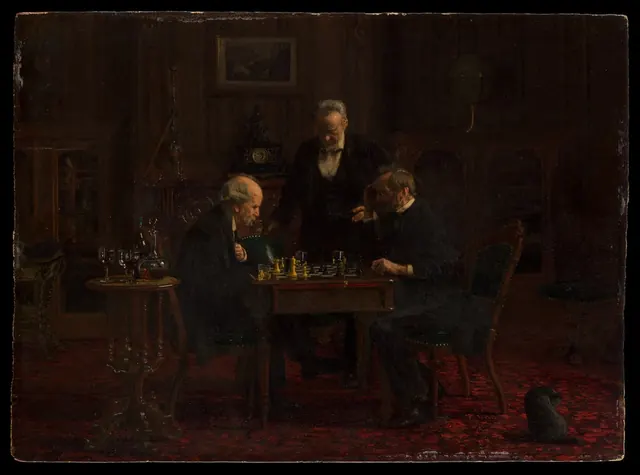
The painting’s story and details
Two friends play chess while a third watches the board standing up. He is Thomas Eakins’s father, Benjamin. The French teacher Bertrand Gardel sits on the left and the painter George Holmes on the right. Eakins painted this familiar circle in 1876 on a wooden panel only forty-three centimetres wide. Within that small work he brought together the history of his education. His father and these friends had helped him become an artist; now he painted their portraits.
Benjamin bows his head to follow the game from behind the players. His figure completes the close group above the table. On its drawer is a Latin signature in which Thomas identifies himself as Benjamin Eakins’s son. The artist’s mark becomes a dedication to his father. Reading it in the original requires looking closely. A family relationship is embedded within a carefully painted object, and discovering it changes the meaning of this scene of leisure.
Gardel leans towards the pieces with a hand near his chest. He and Holmes supported Eakins before his departure for Paris in 1866. Gardel supplied letters of recommendation, while Holmes advised him on what to see in the Louvre. Their friendship extended well beyond domestic gatherings. An artistic education depended on personal connections and the generosity of others. The painting returns to these men some of the attention they had once given a young painter.
A reproduction of a painting by Jean-Léon Gérôme, Eakins’s teacher in Paris, hangs above the fireplace. The French mentor is present through his own work. His academic lessons also register in the construction of the room. Table edges, furniture and walls are coordinated so that a small panel becomes a deep interior. A surviving preparatory drawing shows Eakins calculating perspective. The apparently natural encounter rests on precise advance planning.
Light and dark pieces occupy the narrow illuminated strip of the board. Holmes has brought a hand towards his face, while Gardel leans forward. The players pause in thought, inviting us to slow down too. Eakins shows no spectacular moment of victory. Attention rests on the people gathered around a small playing field.
A red carpet covers the floor, and a decanter and glasses stand on a side table. Scholar William Hauptman identifies the room with Gardel’s Germantown house and emphasises its expensive furnishings. Such a parlour was intended for receiving guests and displayed its owner’s prosperity. Chess belongs among the comforts of a cultivated life. The setting reveals some of the material conditions that sustained relaxed companionship and the assistance these friends offered the young Eakins.
In 1881 Eakins gave The Chess Players to the Metropolitan Museum. It became the first work the museum accepted as a gift from a living artist. A private remembrance gained a public audience while retaining its domestic scale and discreet dedication. The players’ names now require research, but their shared concentration remains understandable without explanation. The painting shows how an artist can honour people who supported him through an ordinary activity to which they willingly gave their time.
Featured in tours
For children. Everyday life before us
Homes, school, trains and games in twelve paintings. For ages 8–12 and adults.
More paintings to compare

Period, style and subject
- Movement
- Realism
- Genre
- Everyday life
- Medium
- Oil on wood
- Collection
- The Metropolitan Museum of Art
- Dimensions
- 29.8 × 42.6 cm
- Accession number
- 81.14
Sources
Image provided under CC0. Image licence