The Dead Toreador
Édouard Manet · probably 1864
Explore the painting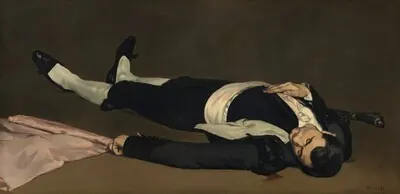
The painting’s story and details
This man once lay within a large bullfighting scene. Manet showed it at the Salon of 1864, then cut two sections from the canvas and reworked them as independent paintings. The dead toreador remains here. Another fragment, showing the active arena, belongs to the Frick Collection. The emptiness around the body resulted from revision and completely changed the effect of the subject.
His head turns towards his shoulder, his eyes closed. Light catches his hair and the edge of a face barely separated from the black sleeve. The image comes so close that the distance between viewer and victim is much smaller than the usual distance from the stands to the arena.
The white sash and exposed jacket lining cross the dark figure. Small red marks appear on the hand at his chest and the white fabric; blood stains the ground beneath his shoulder. Manet keeps the evidence of injury sparse. It can be missed among the strong black and white shapes, yet it changes the meaning of the body’s stillness.
The legs recede diagonally to the left. White stockings link the distant feet with the white cloth at the waist. The long, low format repeats the body’s position. Even the edges of the painting emphasise its horizontality.
Pink cloth spreads beside the outstretched hand. Its folds extend beyond the lower edge, continuing the arm’s direction to the left. A prop of the spectacle remains beside the dead man, now motionless. Muted pink slightly softens the stark combination of black costume, white stockings and brown earth.
Above the body are no spectators, bull or recognisable barrier. The brown background darkens towards the top, leaving the man in a space without clear limits. Once the surrounding scene was removed, there was no way to follow the continuing fight. Its outcome now holds all the attention, whereas on a crowded canvas it would have been only part of the action.
The original painting was harshly criticised and caricatured. That may have prompted Manet to cut it, but the precise reason remains unknown. In 1999 the two fragments were displayed together for the first time since leaving his studio. Caricatures and X-rays helped scholars investigate the original composition. Its full history remains disputed; today we know above all the two new paintings Manet made from a poorly received work.
More paintings to compare


Period, style and subject
- Movement
- Realism
- Genre
- History painting
- Medium
- oil on canvas
- Collection
- National Gallery of Art, Washington
- Dimensions
- Overall, 75.9 × 153.3 cm
- Accession number
- 1942.9.40
Sources
Reproduction of a public-domain artwork. Image licence