Orphaned
Nikolai Kasatkin · 1891
Explore the painting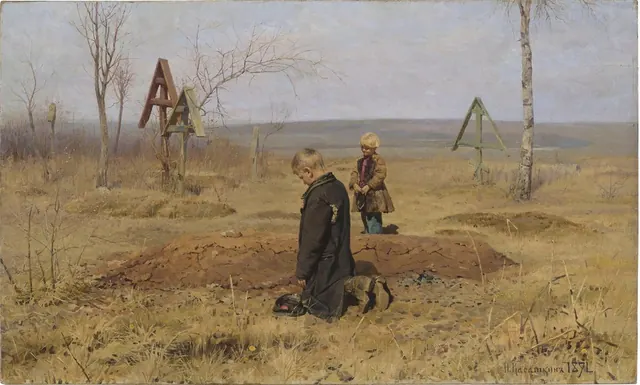
The painting’s story and details
Two boys remain beside a fresh grave. Nikolai Kasatkin titled his 1891 painting Orphaned; the Russian Museum identifies them as brothers. He studied under Vasily Perov and Illarion Pryanishnikov and joined the Wanderers in the year he painted it. His interest in poverty and vulnerability continued the tradition of genre painting. Here a social concern centres on two children facing life after losing a parent.
The nearer boy kneels with his head lowered. His removed cap is lowered towards the ground, and dark clothing almost joins the earth. A tear in the sleeve is clear. Kasatkin keeps the face partly turned away and avoids a large expressive gesture.
The other child stands across the grave, holding his cap before him. Fair hair stands out against grey, with a red shirt visible beneath brown clothing. Space separates the brothers, yet both figures face the same place. Kasatkin gives them different positions rather than repeating a gesture. A shared loss appears through separate responses visible in the tilt of a head and a way of standing.
Fresh earth forms a long mound between the children. Large clods differ in colour from the dry grass around them. The grave crosses the middle of the painting and connects the figures. It is the clearest trace of a recent event. The funeral itself is absent; earth and children remain afterwards. Attention moves from what happened towards those left behind.
Wooden crosses with small pitched roofs stand on the left. Paint has faded and boards differ in colour. More grave markers appear beyond. Small variations among the crosses suggest time between burials. The fresh mound occupies a place among older traces of other losses.
On the right a cross and birch rise above a low horizon. Empty sky and ground separate them from the children. Branches are almost bare, grass has faded, and the distance contains little movement. The visible emptiness makes the absence of other people palpable. No adult is visible nearby within the broad space.
The signature and date sit in the lower right among short strokes of dry stems and small dark clumps of earth. This passage is easy to miss while watching the figures, yet it reveals attention to the cemetery’s ordinary surface. There is no elaborate monument or floral display. The cemetery’s plain arrangement matches the children’s worn clothes.
The title establishes orphanhood without supplying a detailed family history. The children’s visible vulnerability matters. Sympathy for loss can lead to another question: who will now care for those remaining beside the grave? No answer appears. Private grief is shown in circumstances where the absence of adult support becomes as conspicuous as the fresh earth.
Featured in tours
Russian life. Estate, city and village
How nineteenth-century painters depicted work, wealth, education and changes in everyday life.
More paintings to compare

Period, style and subject
- Movement
- Realism
- Genre
- Everyday life
- Medium
- Oil on canvas
- Collection
- State Russian Museum
- Dimensions
- 51 × 88 cm
- Accession number
- Ж-5638
Sources
Public domain. Reproduction from Wikimedia Commons. Image licence