Breezing Up (A Fair Wind)
Winslow Homer · 1873-1876
Explore the painting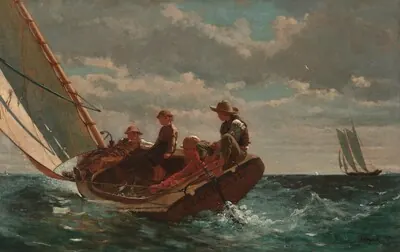
The painting’s story and details
A small sailboat crosses the waves. It carries an adult and three boys, with a child holding the tiller. Homer worked on the painting from 1873 to 1876. Numerous compositional revisions lie behind this apparently effortless maritime episode. It reached audiences during the United States centennial, when questions about the country’s future after the Civil War gave even peaceful subjects particular significance.
The passengers sit close together but in different postures. One boy reclines near the sail, another grips the side, and the adult works a rope. Their adjustments make the boat’s tilt visible. A common rhythm emerges from separate actions. Moving through the water involves even the person who simply shifts their weight and holds their position.
The boy at the stern sits high with his bare feet drawn up. His hand is by the tiller, and he looks in the direction of travel. In an earlier treatment, the adult had control. Giving it to a child changed the distribution of responsibility. This is a real duty within the scene, as well as a detail viewers could associate with trust in the next generation.
The sail extends beyond the upper edge. Its angle, taut rigging and the hull’s heel show the wind’s force. The large pale fabric balances the dark group of people. This cropped view brings the boat very close. We see part of its rigging from a distance too short to take in the entire vessel.
Another vessel with narrow sails travels in the distance on the right. Open water separates it from our boat. Repeated sail shapes establish depth, while the intervening space gives the foreground group room to move. Homer leaves the sea open and visibly unsettled. Pale wave crests continue all the way towards the horizon.
The near stern rises high, displaying the name Gloucester. White foam flashes beneath the rudder. This part of the boat makes its heel and contact with the wave especially clear. The boy sits directly above moving water, yet his posture remains composed. The scene gains conviction through the close relationship between the sea’s force and people’s accustomed ways of handling it.
An anchor lies in the bow. The museum connects it with the traditional emblem of hope and the painting’s optimistic reception in 1876. That reading has a historical basis, although the people themselves are engaged in an ordinary maritime activity. Homer had previously worked as a war correspondent. His viewers could now imagine a future in a boat where an adult works alongside children and a boy steers the course.
Featured in tours
American landscape. Land and its inhabitants
Nature, territorial expansion, the Civil War and urban life in American painting.
More paintings to compare
Period, style and subject
- Movement
- Realism
- Genre
- Marine painting
- Medium
- oil on canvas
- Collection
- National Gallery of Art, Washington
- Dimensions
- Overall, 61.5 × 97 cm
- Accession number
- 1943.13.1
Sources
Reproduction of a public-domain artwork. Image licence