Right and Left
Winslow Homer · 1909
Explore the painting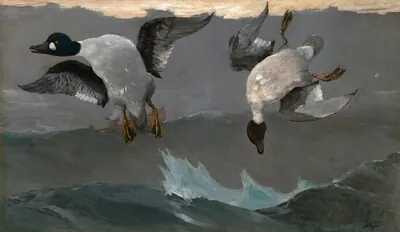
The painting’s story and details
Two ducks are caught in gunfire. One still holds its wings open; the other has turned head down. The hunter in a boat is so small that we may notice him only after the birds. Homer painted this in 1909, near the end of his life. The title is a hunting term for two successive hits with a double-barrelled shotgun. The shooter’s skill becomes a sudden catastrophe for his targets.
The left bird turns its head, spreading its wings across almost its entire half of the painting. Its white breast stands out against the grey surroundings. The golden eye and patch beside the bill remain sharply visible. This close view gives an individual duck the importance of a principal character.
The right duck loses its usual bodily orientation. Its feet point up, its head down, and its wings bend at different angles. The two birds differ sharply despite their similar plumage. Homer arrests the action at such close range that flight and falling occupy the same space. Seeing both poses at once makes the speed of a living creature’s change of state palpable.
Beyond the left duck’s feet is the hunter. Grey smoke almost conceals him, while a tiny red mark indicates the shot. His gun points towards the birds and also towards us. This arrangement changes the viewer’s position. Watching someone else’s hunt, we find ourselves in the line of fire and at the victims’ height. The small distant figure controls the entire foreground event.
The wave below raises a sharp turquoise crest. Dark water is painted in long bands succeeding one another towards the horizon. Unlike the sharply outlined bodies, the sea consists of broad masses. Against them the falling bird seems particularly fragile. Water continues to move, and the fall leads into the same space that now forms the bird’s background.
A narrow warm strip of light remains along the upper edge. It occupies little space among cool greys and greens. The horizon is so high that the birds have almost no sky. Their large bodies feel confined within the picture. The sea’s breadth survives in the distance, but the close view concentrates on a few seconds above the water.
From 1883 Homer lived mainly on the Maine coast, where the sea became a constant subject. Here familiar surroundings become a scene of extreme vulnerability. The museum connects the late painting with mortality. That theme is especially palpable through the chosen distance. To the hunter the birds are distant targets; to us they almost obscure the entire world.
Featured in tours
American landscape. Land and its inhabitants
Nature, territorial expansion, the Civil War and urban life in American painting.
More paintings to compare
Period, style and subject
- Movement
- Realism
- Genre
- Everyday life
- Medium
- oil on canvas
- Collection
- National Gallery of Art, Washington
- Dimensions
- Overall, 71.8 × 122.9 cm
- Accession number
- 1951.8.1
Sources
Reproduction of a public-domain artwork. Image licence