The Peppermint Bottle
Paul Cezanne · 1893/1895
Explore the painting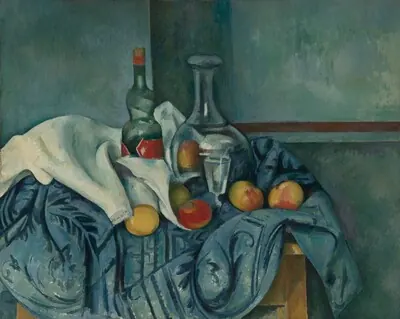
The painting’s story and details
In the 1890s Cezanne repeatedly assembled still lifes from bottles, vessels, fruit and fabrics. This one, painted around 1893–1895, is held together by cool blue-green colours. A red label and warm fruit stand out within them. The objects are ordinary, but their arrangement is carefully constructed: folds lift some things, conceal the bases of others and almost completely cover the table.
To the left of the carafe stands a shaped green bottle with a stopper. Its red label is conspicuous, though the lettering is unreadable. A narrow neck and swelling body form an uneven vertical. White cloth curls around the base, embedding the bottle among folds. A small red area beside the stopper repeats the label’s colour at another height.
The carafe occupies the centre. Its rounded body catches colours from nearby objects, while its neck rises almost as high as the bottle. A glass stands in front, overlapping the outlines of the two transparent vessels. Dark boundaries and a few pale areas give the glass volume. Reflections connect it with the surrounding fruit and cloth.
Two yellow-red fruits lie at the right. Separate strokes move across their surfaces, building roundness. Another fruit in front of the glass is mainly red; a green one appears farther left. Repeated circular forms lead between the groups. Colour and shadows where they meet the fabric convey their weight.
A white cloth rises behind the bottle and falls to the left in large folds. Blue and green enter its shadows, keeping it connected to the cool surroundings. The pale fabric separates the two dark vessels and distinguishes them from the wall. A finished hem appears at the edge, a small domestic detail within the broad colour arrangement.
Blue patterned fabric fills the lower area. Its stripes and scrolls bend with the folds, at times seeming to project towards us. A piece of wooden table appears between them at the right. Abundant drapery makes its entire plane difficult to reconstruct. Each vessel is clear enough, though the overall space beneath the objects remains complex and unsettled.
In 1929 this still life appeared in the inaugural exhibition of New York’s Museum of Modern Art. Cezanne was presented alongside Gauguin, Seurat and Van Gogh. Household objects became part of a new museum history of painting. What mattered were relationships of form, colour and space that the painter could investigate on his own table without a grand historical subject.
Featured in tours
After Impressionism. Four different answers
Seurat, Cézanne, Van Gogh and Gauguin changed painting for different reasons.
Still life. The value and structure of things
Food, flowers, vessels, books and instruments in an owner’s life and a painter’s work.
More paintings to compare


Period, style and subject
- Movement
- Post-Impressionism
- Genre
- Still life
- Medium
- oil on canvas
- Collection
- National Gallery of Art, Washington
- Dimensions
- Overall, 65.9 × 82.1 cm
- Accession number
- 1963.10.104
Sources
Reproduction of a public-domain artwork. Image licence