Life Everywhere
Nikolai Yaroshenko · 1888
Explore the painting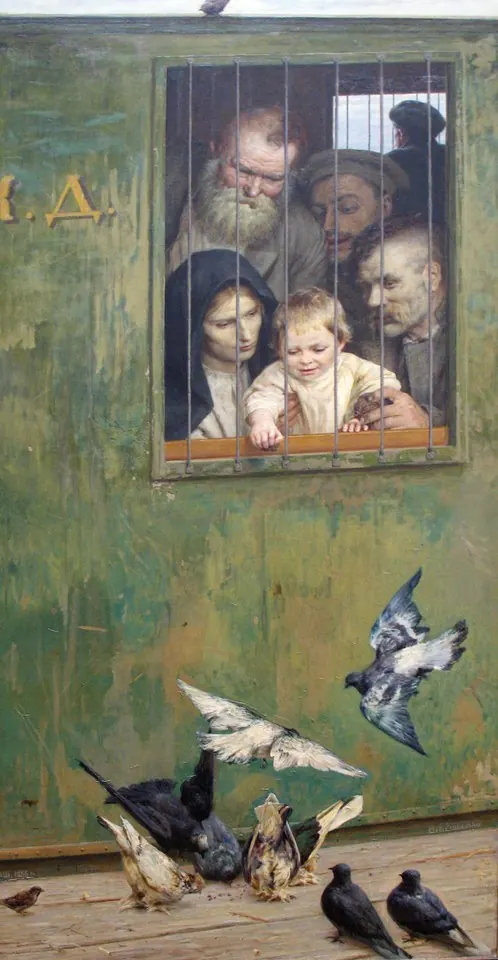
The painting’s story and details
People behind the bars of a prison railway carriage watch a child feeding birds. Nikolai Yaroshenko painted Life Everywhere in 1888. Exile and imprisonment were part of Russian public life, and he knew members of the populist movement. Prisoners’ circumstances were no abstract subject for him. Here he presents a small incident: a child reaches towards pigeons, and the movement gathers several adults around him.
The child reaches between the bars, steadying himself against the sill with his other hand. Adults support him from either side. His pale shirt and face stand out against the dark carriage. The gesture joins the painting’s upper and lower parts: people above, birds waiting below. Bars remain visible across this simple connection. Taking part in an ordinary outdoor activity requires the child to reach through a barrier.
The mother inclines her head towards the child. A dark-blue covering forms an almost triangular frame around her face above pale clothing. The Tretyakov Gallery notes the group’s resemblance to a Madonna. The writer Stefania Karaskevich posed for the mother. A familiar image of mother and child appears in a contemporary railway carriage. Its connection to religious painting gives the prisoner the dignity traditionally accorded to Mary.
A bearded man leans above the woman. Two more faces appear nearby, one almost level with the child. The window is crowded, yet age, hair and clothing distinguish each person. Their attention is directed downwards towards one activity. We encounter their closeness before learning anything about their histories. Documents, charges and sentences remain outside the image. Faces provide our first introduction.
Farther inside, a person faces the opposite window. A light opening and another grille appear behind the dark figure, revealing that the close group occupies only part of the carriage. This person does not join the shared incident. Yaroshenko preserves that difference in behaviour. The prisoners do not become a crowd reacting identically even when the painting places them in shared circumstances.
Pigeons gather around crumbs below, with a small sparrow nearby on the boards. Some birds bend towards the food while others wait. Horizontal planks establish the platform’s solid surface. A blank green wall occupies much of the space between it and the window. The distance from the outstretched hand to the birds feels especially large. Feeding becomes a conspicuous event against an almost empty background.
Two pigeons are airborne. The bird on the right spreads its wings widely; the pale one below holds them almost horizontally. Different positions let the eye complete the movement against the solid carriage side. Flying birds beside a barred window suggest freedom without abandoning the scene’s ordinary basis. They have come for food; the people’s circumstances lead us to see more in that action.
According to Karaskevich’s recollections, Tolstoy’s story What Men Live By informed the conception. The painting brings a question about human fellowship into a place of punishment. Viewers can respond compassionately without knowing whether the people are guilty. Yaroshenko offers no legal judgment. He makes care for a child and shared attention to birds visible despite the bars. A familiar everyday scene becomes grounds for considering how society regards prisoners.
Featured in tours
Russian life. Estate, city and village
How nineteenth-century painters depicted work, wealth, education and changes in everyday life.
More paintings to compare


Period, style and subject
- Movement
- Realism
- Genre
- Everyday life
- Medium
- Oil on canvas
- Collection
- State Tretyakov Gallery
- Dimensions
- 213.7 × 107.5 cm
- Accession number
- 701
Sources
Public domain. Reproduction from Wikimedia Commons. Image licence