Young Girl Reading
Jean Honoré Fragonard · c. 1769
Explore the painting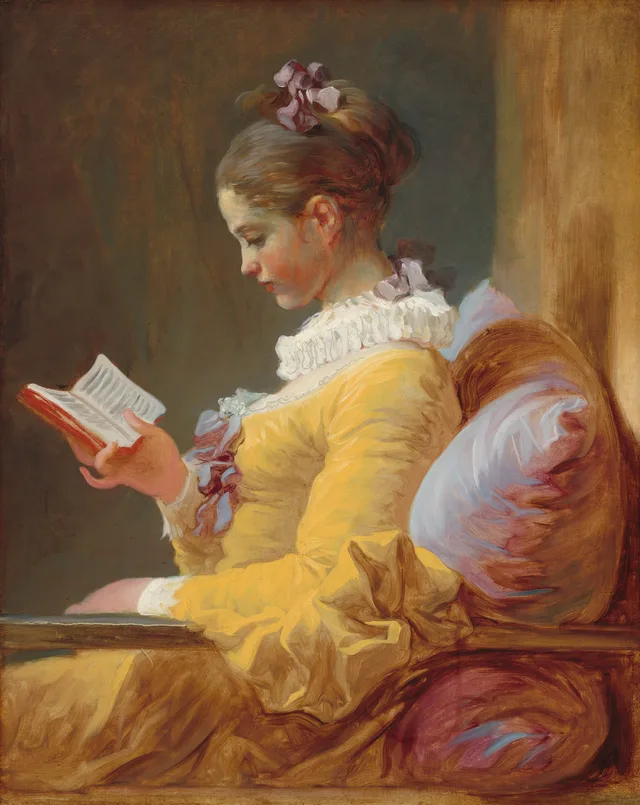
A girl sits comfortably with a small book, paying us no attention. Fragonard painted the work around 1769, but this pose came later. Examination beneath the surface revealed a face originally turned toward the viewer. He subsequently redirected it toward the book, transforming an encounter with a sitter into observation of someone occupied with her own reading.
The profile is more controlled than the clothing. Inclined head, lowered eyes, and gently closed lips establish concentration. A small gap between face and book directs attention downward. The quiet activity becomes clear without outward gestures. The reader follows her own rhythm, and the viewer must adapt to it.
The book fits in one hand. Short marks suggest print without revealing a title, leaving the reading’s purpose open. More visible are the conditions that make it possible: quiet time, comfortable seating, and leisure. Cushion and dress remind us that absorbed reading also has a material setting.
Broad, rapid strokes describe the yellow dress, with brown and violet shadows preventing the color from flattening. Fragonard worked wet paint into still-wet layers in places. Close up, a fold separates into movements of the hand; from farther away it becomes fabric again.
The white collar seems delicately laced, although some details were made by dragging the brush handle through wet paint. Using both ends of the tool varied the surface and suggested fine cloth without copying every thread. Conviction depends on the eye completing an impression from a few well-chosen marks.
A large pink-lilac cushion supports her back. Its loose strokes echo the yellow sleeve while a wooden support anchors the lower composition. The furnishings stabilize the reading pose even as the painted surface remains lively. The sitter’s stillness and the brushwork’s speed give the picture two distinct rhythms.
The painting belongs with Fragonard’s fantasy figures, featuring acquaintances in striking costumes. Yet revision gave it a distinct character. Turned away from the audience, the sitter’s dress no longer demands an immediate response and reading takes precedence. The reason for the change remains unknown, but its effect on our way of looking is directly perceptible.
Featured in tours
Domestic life. Leisure and care
Sixteen paintings about reading, music, children and the work that makes domestic comfort possible.
More works by Jean Honoré Fragonard
- Medium
- oil on canvas
- Collection
- National Gallery of Art, Washington
- Dimensions
- 81.1 × 64.8 cm
- Accession number
- 1961.16.1
Sources
Museum reproduction. Public domain, NGA Open Access. Image licence